Missing a tooth can affect more than your smile. It may make chewing uncomfortable, change the way you speak, and affect how your remaining teeth fit together. Fortunately, modern restorative dentistry offers several ways to replace missing teeth, and dental bridges remain a popular option.
However, not every dental bridge works the same way. Some use crowns placed over neighboring teeth, while others rely on small bonding wings or dental implants for support. Choosing the right design depends on the number of missing teeth, the condition of your surrounding teeth, your bite, and your overall oral health.
If you are researching affordable dental bridges in Norristown, understanding these options can help you prepare for a more productive conversation with your dentist.
This guide explains the four main types of dental bridges, their benefits, limitations, treatment considerations, and how to care for your replacement teeth.
What Is a Dental Bridge?
A dental bridge is a fixed dental restoration that replaces one or more missing teeth. It fills the space with artificial teeth and uses natural teeth or dental implants for support.
A bridge generally contains two important components:
- Abutments: The natural teeth or dental implants that support the bridge.
- Pontics: The artificial teeth that fill the missing spaces.
Depending on its design, a dental bridge can replace a single missing tooth or several consecutive missing teeth.
Think of a dental bridge as a small construction project inside your mouth. The replacement tooth needs reliable support, and the supporting structure must handle everyday chewing forces.
4 Main Types of Dental Bridges
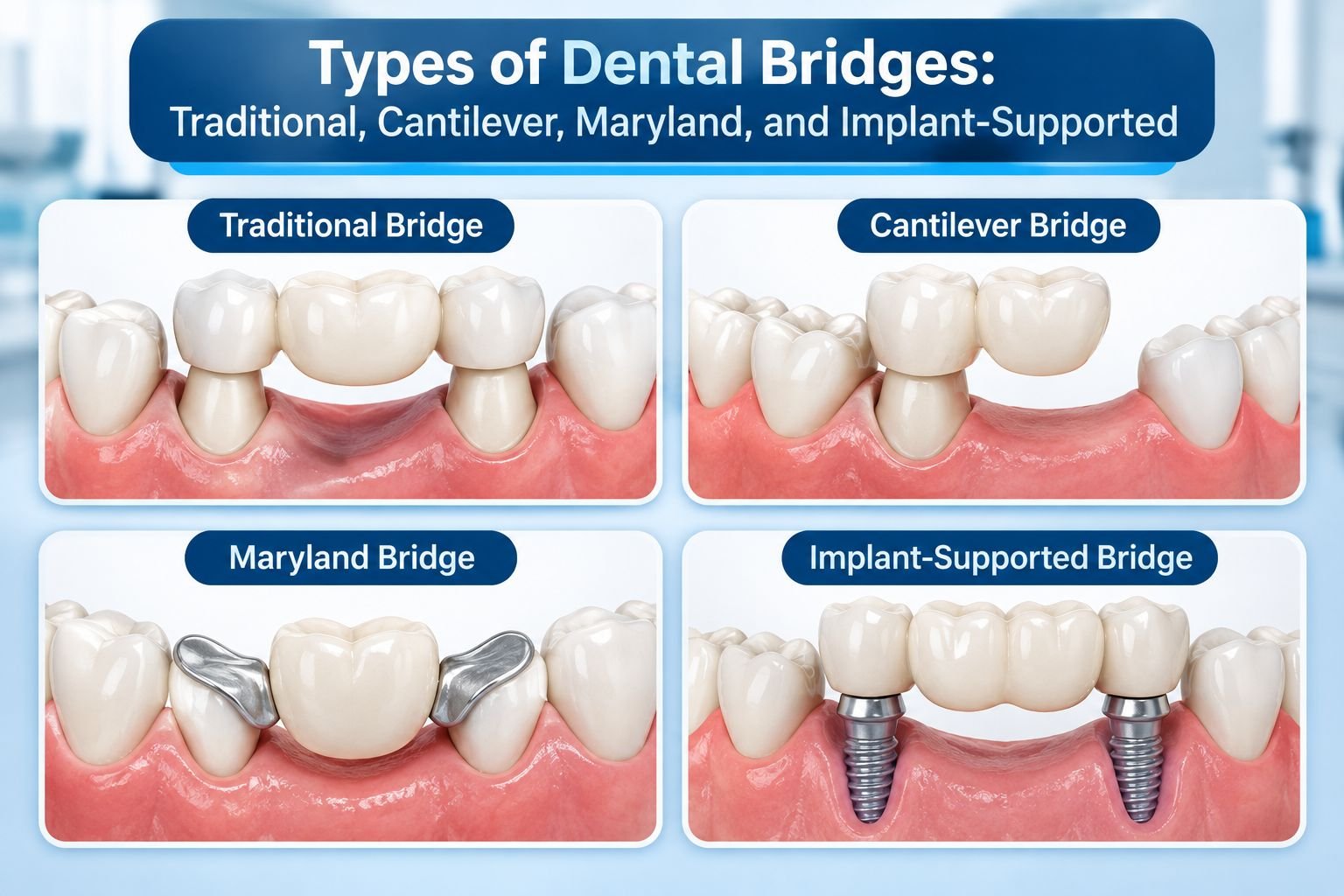
Dentists generally consider four main designs when planning dental bridge treatment. Each has a different attachment method, level of support, and ideal application.
1. Traditional Dental Bridge
A traditional dental bridge is one of the most commonly used options for replacing missing teeth.
It consists of an artificial tooth connected to dental crowns on both sides. The crowns fit over the natural teeth next to the gap, holding the replacement tooth securely in position.
How does it work?
Your dentist prepares the neighboring teeth by reshaping their outer surfaces. The dental laboratory then creates a custom bridge that fits over those supporting teeth and fills the missing space.
The dentist checks the fit and bite before permanently cementing the restoration.
Benefits of traditional bridges:
- Provide stable support for replacement teeth.
- Restore chewing function.
- Fill visible gaps in your smile.
- Help prevent neighboring teeth from shifting into the space.
- Can replace one or more consecutive missing teeth when adequate support exists.
Possible limitations:
- Supporting teeth require permanent enamel removal.
- The crowned teeth can still develop decay.
- Cleaning underneath the replacement tooth requires extra attention.
A traditional bridge may suit someone who has healthy, sufficiently strong teeth on both sides of the missing space. However, your dentist must examine those teeth before recommending this option.
2. Cantilever Dental Bridge
A cantilever dental bridge uses support from only one side of the missing tooth.
Unlike a traditional bridge, which usually attaches to supporting teeth on both sides, this design connects the artificial tooth to a single supporting tooth.
How does it work?
The dentist prepares one neighboring tooth and places a crown over it. The replacement tooth extends from that crown into the space.
This design can help when a suitable supporting tooth exists on only one side of the gap.
Benefits of cantilever bridges:
- Require only one supporting natural tooth.
- Can replace a missing tooth in selected situations.
- Offer a fixed replacement rather than a removable appliance.
Possible limitations:
- Place additional pressure on the supporting tooth.
- Have more limited applications than traditional bridges.
- May not suit areas that experience heavy chewing forces.
Because only one tooth supports the replacement, careful bite assessment matters. A cantilever bridge may work in certain low-stress areas, but it does not suit every missing-tooth situation.
Your dentist must evaluate the location of the gap and the strength of the supporting tooth before recommending it.
3. Maryland Dental Bridge
A Maryland bridge, also called a resin-bonded bridge, uses small wings attached to the backs of neighboring teeth.
Instead of placing full crowns over supporting teeth, the dentist bonds these wings to the natural teeth using dental resin.
Dentists often consider this design when replacing a missing front tooth.
How does it work?
The bridge contains an artificial tooth connected to a metal or ceramic framework. The framework’s wings attach to the back surfaces of neighboring teeth.
This approach generally requires less alteration of natural tooth structure than a traditional bridge.
Benefits of Maryland bridges:
- Preserve more natural tooth structure.
- Usually require less preparation of neighboring teeth.
- Can provide an aesthetic option for replacing selected front teeth.
- Offer a fixed replacement without placing full crowns on adjacent teeth.
Possible limitations:
- The bonding material can loosen over time.
- May not withstand heavy biting forces.
- Requires suitable supporting teeth and bonding surfaces.
- May not work well for certain bite patterns.
For example, a Maryland bridge may be an option when someone loses a front tooth but has healthy neighboring teeth.
However, the back teeth experience different chewing forces. That is why dentists generally reserve this design for carefully selected cases.
4. Implant-Supported Dental Bridge
An implant-supported bridge uses dental implants instead of natural teeth to support replacement teeth.
Dental implants are small posts that a dental professional places in the jawbone. They act as artificial tooth roots and provide a foundation for the bridge.
This option can be useful when someone has several missing teeth in a row.
How does it work?
The dentist or oral surgeon places dental implants into the jawbone. The implants then need time to heal and integrate with the surrounding bone.
After healing, the dental team attaches the custom bridge to the implants.
The number of implants required depends on the length of the missing-tooth area, bone conditions, and the treatment plan.
Benefits of implant-supported bridges:
- Do not require crowns on neighboring natural teeth for support.
- Can replace several consecutive missing teeth.
- Provide support through dental implants.
- Help preserve the jawbone around the implant sites through functional stimulation.
Possible limitations:
- Require oral surgery.
- Need sufficient bone support or additional procedures in some cases.
- Usually involve a longer treatment timeline.
- May cost more than conventional tooth-supported bridges.
An implant-supported bridge may suit someone who wants to replace multiple missing teeth without using neighboring natural teeth as support.
Interesting Read: 15 Expert Tips to Make Your Dental Bridges Last Longer
Traditional vs Cantilever vs Maryland vs Implant-Supported Bridges
Understanding the differences becomes easier when you compare how each design supports replacement teeth.
| Feature | Traditional | Cantilever | Maryland | Implant-supported |
| Main support | Two or more natural teeth | One natural tooth | Bonded wings | Dental implants |
| Tooth preparation | Crown preparation | Crown preparation | Usually minimal | Implant surgery |
| Common application | Missing teeth between natural teeth | Selected low-stress areas | Often front teeth | Multiple missing teeth |
| Main consideration | Supporting teeth must be suitable | Pressure on one supporting tooth | Bonding strength | Bone health and healing |
No single design works for everyone. Your dentist considers your oral health, bite, remaining teeth, and treatment goals before recommending a bridge.
How Do You Know Which Dental Bridge Is Right for You?
Choosing a dental bridge involves more than deciding which option looks attractive. Your dentist needs to determine whether your mouth can support the proposed restoration.
Here are some important factors that influence the decision.
1. Number of Missing Teeth
The number of missing teeth helps determine which bridge designs may work.
A traditional bridge may replace one or several consecutive missing teeth when suitable supporting teeth remain. An implant-supported bridge may be considered when multiple teeth are missing.
2. Condition of Neighboring Teeth
The health of your surrounding teeth matters.
If the neighboring teeth already have large fillings or require crowns, a traditional bridge may be worth discussing.
However, preparing healthy teeth for crowns involves permanently removing some enamel. Your dentist should explain this consideration before treatment.
3. Location of the Missing Tooth
Front teeth and back teeth perform different jobs.
Front teeth help with biting and appearance, while back teeth handle much of the heavy chewing. A Maryland bridge may work for selected front-tooth replacements, while other designs may provide more suitable support elsewhere.
4. Jawbone and Gum Health
Implant-supported bridges require suitable bone support and healthy surrounding tissues.
If you have experienced bone loss or gum disease, your dentist may recommend additional evaluation or treatment before considering implants.
5. Budget and Long-Term Maintenance
Treatment cost matters, but the lowest initial price does not automatically mean the most economical choice.
Consider the treatment process, expected maintenance, supporting teeth, and potential future dental work.
If you are comparing affordable dental bridges in Norristown, ask your dental provider to explain the benefits, limitations, and total estimated costs of each suitable option.
What Is the Dental Bridge Procedure Like?
The treatment process depends on the type of bridge you receive. However, conventional bridges generally involve several stages.
Step 1: Dental examination
Your dentist examines your teeth and gums, reviews your dental history, and may take X-rays to assess the supporting structures.
Step 2: Treatment planning
The dentist determines which bridge design may work for your situation. You can discuss materials, treatment costs, and alternatives before proceeding.
Step 3: Preparing the supporting teeth
For a traditional bridge, the dentist reshapes the supporting teeth to accommodate dental crowns.
Maryland bridges generally require less tooth preparation, while implant-supported bridges involve a surgical procedure.
Step 4: Impressions and bridge creation
Your dentist takes impressions or digital scans to help create a restoration that fits your mouth.
A temporary bridge may protect prepared teeth while the dental laboratory makes your permanent restoration.
Step 5: Final placement
The dentist checks the bridge’s fit, appearance, and bite before securing it.
For implant-supported bridges, final placement takes place after the implants have healed sufficiently.
According to the Cleveland Clinic’s dental bridge procedure guide, conventional bridge preparation and final placement often involve separate appointments.
How to Care for Your Dental Bridge
Getting a dental bridge is only one part of maintaining a healthy smile. Your daily oral hygiene habits also influence how well the restoration performs over time.
Follow these practical care tips:
- Brush twice daily with a soft-bristled toothbrush.
- Clean around the bridge and supporting teeth carefully.
- Use a floss threader or suitable interdental cleaning aid to clean underneath the artificial tooth.
- Attend regular dental examinations and professional cleanings.
- Avoid using your teeth to open packages or bite hard objects.
- Contact your dentist if the bridge becomes loose, cracks, or causes discomfort.
One important detail: a dental bridge cannot develop cavities like a natural tooth, but the supporting natural teeth can still develop decay. Plaque can also collect around the bridge and affect your gum health.
Good maintenance helps protect both the restoration and the natural teeth supporting it.
What Are the Alternatives to Dental Bridges?
Dental bridges are not the only way to replace missing teeth.
Depending on your oral health and preferences, your dentist may discuss other options.
1. Dental implants: An individual implant with a crown can replace a single missing tooth without using neighboring teeth for support.
2. Removable partial dentures: These appliances replace missing teeth and can be removed for cleaning.
3. Other restorative options: Your dentist may recommend different treatments depending on the number of missing teeth and the condition of your remaining teeth.
Each option has different costs, treatment requirements, and maintenance considerations.
A thorough examination helps determine which choices are appropriate.
Finding a Dentist for Dental Bridge Treatment
Choosing the right dental provider is an important part of restoring your smile.
When researching a Norristown dentist, look for a practice that takes time to understand your dental concerns and explains available treatment options clearly.
Before starting treatment, consider asking:
- Which dental bridge types are suitable for my situation?
- Will the procedure require altering my natural teeth?
- How long will the treatment take?
- What materials will you use?
- What maintenance will my bridge require?
- What is the estimated total treatment cost?
- Are there alternative treatments worth considering?
Clear answers help you understand what to expect instead of making a decision based on appearance or price alone.
A dentist should also explain the limitations of the recommended treatment. Every restoration has advantages and potential complications, and an informed patient can make more confident decisions.
Restore Your Smile With the Right Dental Bridge
Dental bridges offer several ways to replace missing teeth, but the right option depends on your individual dental needs.
Traditional bridges provide support through neighboring crowned teeth. Cantilever bridges use one supporting tooth, Maryland bridges rely on bonded wings, and implant-supported bridges use dental implants for stability.
If you are exploring affordable dental bridges in Norristown, take time to understand the available treatments, their long-term maintenance requirements, and their overall costs.
Speaking with an experienced Norristown dentist can help you understand which restoration suits your oral health and smile goals.
At your dental consultation, discuss your concerns, ask questions, and review all suitable treatment options before making a decision. A well-planned restoration should do more than fill a space. It should help you eat comfortably, maintain your oral health, and feel confident about your smile.
Frequently Asked Questions About Dental Bridges
1. What are the four main types of dental bridges?
The four main types are traditional, cantilever, Maryland, and implant-supported bridges. Each uses a different method to support replacement teeth.
2. Which dental bridge is the most durable?
Durability depends on the bridge design, supporting structures, materials, oral hygiene, and individual dental conditions. Your dentist can explain which option offers suitable long-term support.
3. Are Maryland bridges suitable for back teeth?
Maryland bridges generally work better for selected front-tooth replacements because their bonded wings may not withstand the heavier chewing forces in the back of the mouth.
4. Can a dental bridge replace multiple missing teeth?
Yes. Traditional and implant-supported bridges can replace multiple consecutive missing teeth when the supporting structures are suitable. The number of teeth a bridge can replace depends on the treatment plan.
5. Does getting a dental bridge hurt?
Dentists use local anesthesia during procedures that require tooth preparation or implant placement. You may experience some temporary sensitivity or discomfort afterward.
6. How do I clean underneath a dental bridge?
Use a floss threader, bridge floss, or an appropriate interdental cleaning aid to remove food particles and plaque underneath the artificial tooth. Your dentist can demonstrate the correct technique.
7. How much do affordable dental bridges in Norristown cost?
The cost depends on the bridge type, materials, number of replacement teeth, supporting structures, and additional dental procedures. Request an examination and personalized treatment estimate for accurate pricing.